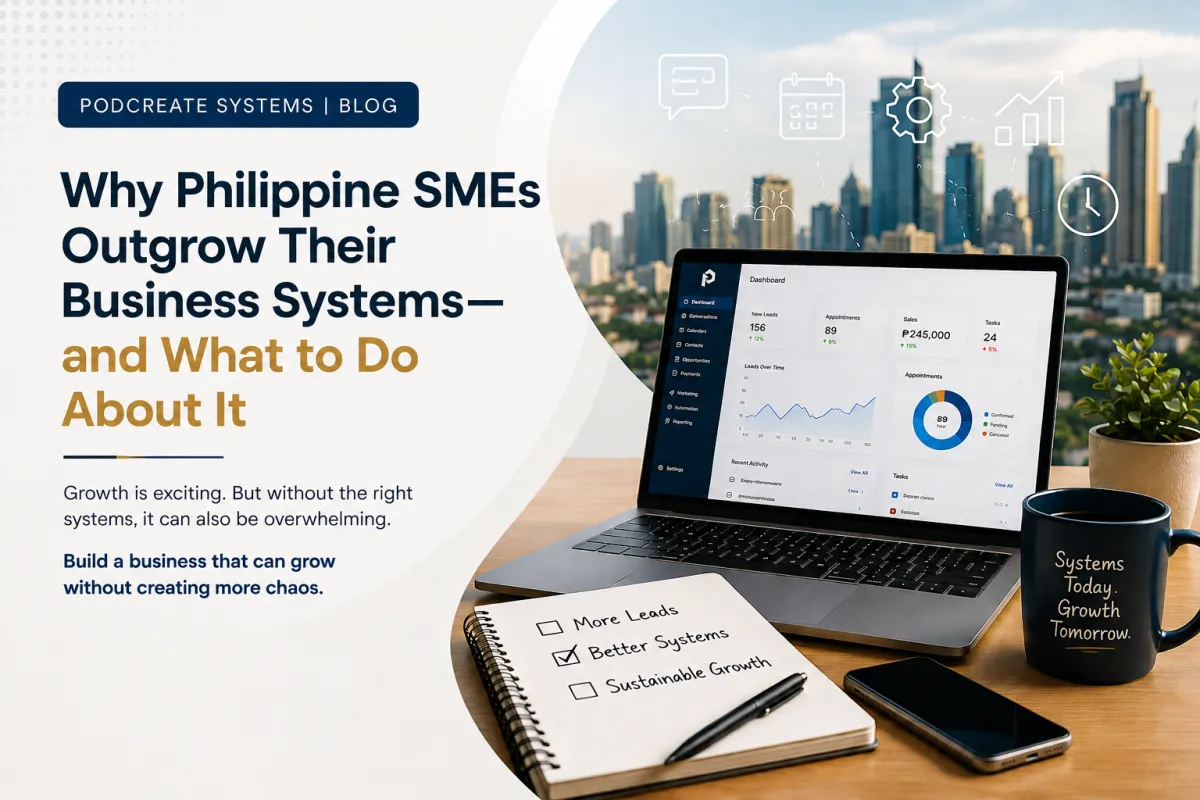
Why Philippine SMEs Outgrow Their Business Systems and What to Do About It
For many Philippine businesses, growth starts in a very familiar way.
A few customers become regular customers. Word of mouth brings in new inquiries. Facebook and Instagram start generating messages. The team gets busier, and more customers begin coming through the door.
At first, this is exactly what you want.
But as the business grows, the way you work often needs to grow with it.
The processes that worked when you were serving a smaller number of customers may need to evolve as inquiries increase, your team expands, and customers expect more convenience.
In my work with service businesses, I often see the same pattern. The business has grown, but the processes behind the customer journey are still being managed the way they were when the business was much smaller.
Messages are coming in from different places. Appointments are being managed manually. Employees are answering similar questions throughout the day. Customer information may live across several tools.
The business is growing, but the way it operates still feels like the business it was a few years ago.
This is an important stage in the life of an SME because it is often the right time to start thinking about business systems more intentionally.
Business systems are the processes, tools, and workflows that help a business manage leads, customers, appointments, communication, and day-to-day operations. As an SME grows, these systems can evolve to help the team serve customers more efficiently and create a more consistent way of working.
Growth Changes the Way a Business Needs to Operate
A lot of businesses in the Philippines are built around relationships, and that is one of our strengths.
Customers message businesses directly. They ask questions before making a decision. They use Messenger, Viber, SMS, phone calls, and social media to communicate with businesses.
When a business is small, this personal approach can work beautifully.
The owner knows what is happening. The team knows the customers. Everyone can keep track of things through conversations, spreadsheets, and a handful of tools.
As the business grows, however, there are more moving parts to coordinate.
There are more inquiries to respond to, more appointments to manage, more customer information to organize, and more people involved in delivering the service.
This is where having clear systems becomes increasingly valuable.
A system gives the team a consistent way to handle everyday processes. It creates visibility, makes responsibilities clearer, and helps everyone understand what needs to happen next.
Instead of relying on one person's memory or a long conversation thread, the business has a process that can support the whole team.
More Leads Become More Valuable When the Business Is Ready for Them
One of the most common conversations around business growth is lead generation.
More leads can certainly create more opportunities. Marketing is an important part of building a healthy pipeline for any business.
But lead generation works best when there is a strong process behind it.
Think about what happens after someone fills out a form, sends a Messenger inquiry, or contacts the business through a website.
Who responds?
How quickly do they receive a reply?
Where is their information recorded?
What happens if they are interested but not ready to book yet?
How does the team know who needs a follow-up?
These questions become increasingly important as a business grows.
A business can generate a steady stream of inquiries, but the real opportunity comes from having a clear process for turning those inquiries into conversations, appointments, and customers.
This is where systems can create leverage.
Instead of simply focusing on bringing more people into the business, you can also improve what happens once they arrive.
A well-designed lead management process helps the team respond consistently, keep track of opportunities, and make sure potential customers continue moving through the journey.
That makes every lead-generation effort more valuable.
A Busy Team Can Benefit From Better Processes
Being busy is a natural part of a growing business.
As customer demand increases, your team has more people to serve and more work to manage.
The opportunity is to make sure their time is being spent on work that truly needs their attention.
Imagine an employee spending part of the day checking appointment availability, copying customer information between systems, answering the same questions repeatedly, sending reminders, and following up with customers individually.
Those tasks may all be necessary, but they do not necessarily require someone to do everything manually.
A well-designed process can take care of some of the repetitive work while keeping the human element where it matters most.
Your team can spend more time talking to customers, solving problems, building relationships, and delivering a great service experience.
That is where automation becomes useful.
It is not about replacing the people behind the business. It is about giving those people better support.
When repetitive tasks are handled through a clear system, employees have more room to focus on the work where their experience, judgment, and personal connection make the biggest difference.
Customers Are Getting Used to Convenience
Customer expectations are also changing.
Filipinos are increasingly comfortable with digital transactions. We order online, make digital payments, communicate through Messenger, book services online, and expect businesses to make the process as convenient as possible.
This creates an opportunity for service businesses to improve the customer journey.
Consider a simple appointment.
A customer visits your website and clicks Book Now. Instead of immediately seeing available schedules, they are directed to Messenger. They ask about availability, wait for a response, and continue the conversation until an appointment is finally confirmed.
Messenger can be an excellent communication channel, especially in the Philippine market.
But it does not always need to carry the entire booking process.
A customer could see available schedules, choose a time, receive confirmation, and get reminders automatically while still having the option to message the business when they need personal assistance.
That creates a smoother experience for everyone.
The customer gets convenience.
The team gets fewer repetitive messages.
The business gets a more consistent booking process.
Small improvements like this can make a noticeable difference as a business grows.
Technology Should Follow the Business
There are so many business tools available today.
CRMs, booking platforms, email marketing, SMS, AI, automation tools, payment systems, analytics platforms, and integrations can all play a role in a modern business.
But I don't believe technology should be the starting point.
Before choosing a tool, it helps to understand how the business currently works.
Where do inquiries come from?
How does the team handle them?
How are appointments scheduled?
Where is customer information stored?
How does follow-up happen?
What happens after someone becomes a customer?
Looking at the entire customer journey gives you a much clearer picture of where technology can create value.
Sometimes the answer is automation.
Sometimes it is connecting two systems that are already being used.
Sometimes it is organizing information in a CRM.
And sometimes it is simply creating a clearer process for the team to follow.
The technology comes after the strategy.
That is what makes a system useful rather than simply adding another tool to the business.
Building Systems Creates Room for Growth
One of the things I enjoy most about working with businesses on their systems is seeing how small process improvements can create more room for growth.
A business does not always need a completely new technology stack to operate better.
Sometimes the opportunity is already within the tools the business has. The missing piece is having a clear process that connects everything together.
At PodCreate Systems, I use the CALMA Framework™ to understand how a business attracts, manages, and serves its customers before deciding what needs to be built.
The first step is understanding the business as it is today.
From there, we look at the customer journey, the team's workflow, the tools already in place, and the areas where the business has an opportunity to become more efficient.
Sometimes that means introducing automation.
Sometimes it means improving the CRM.
Sometimes it means connecting existing platforms.
Sometimes it means simplifying a process that has gradually become more complicated as the business grew.
The goal is always the same: create a system that supports the way the business wants to operate and grow.
Good systems give people clarity.
They make processes easier to follow.
They create a more consistent customer experience.
And they give business owners better visibility into what is happening across the business.
Build for the Business You Are Becoming
Every stage of business brings a different set of needs.
The processes that worked when you were starting out may look different once you have a larger team, more customers, and a steady flow of inquiries.
That is a natural part of growth.
Your systems can evolve alongside you.
For Philippine SMEs, this is an exciting opportunity.
Businesses today have access to technology that can help them operate with more structure, serve customers more conveniently, and give their teams better support.
You do not need to implement everything at once.
The best systems are usually built around the actual needs of the business.
Start with the customer journey.
Understand how your team works.
Identify where time can be used more effectively.
Then introduce the tools and automation that make sense for your next stage of growth.
Because growing a business is not only about getting more customers.
It is also about creating a business that can serve those customers well.
And when your systems support your people, your customers, and your goals, growth becomes much easier to manage.
The question then becomes less about how much more your team can handle and more about how you can build a business that is ready for what comes next.
