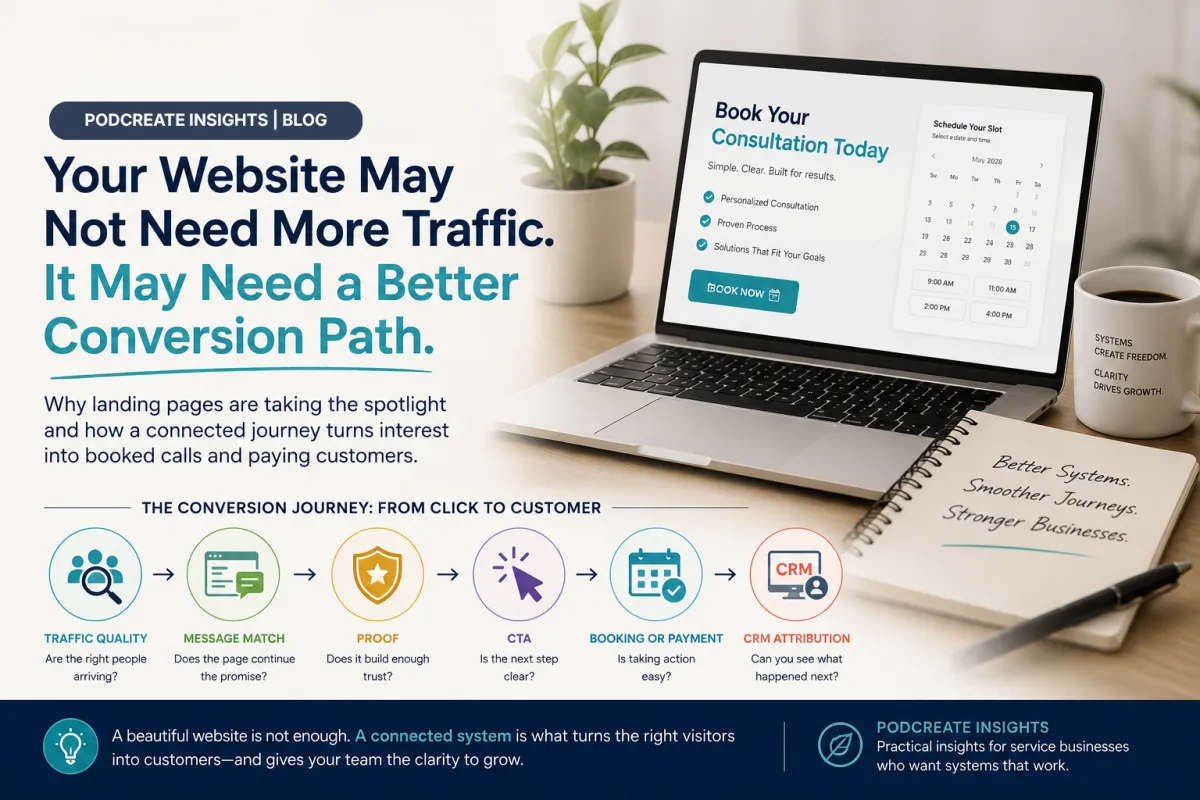
Your Website May Not Need More Traffic. It May Need a Better Conversion Path.
There is something interesting happening in digital marketing right now.
People are still searching. They are still comparing businesses, looking at offers, checking reviews, and trying to decide who they can trust.
But the way they get there is changing.
Recent marketing trend data shows interest in landing pages has increased, while interest in the broader concept of websites has declined. At the same time, AI-generated answers and zero-click search experiences are changing how much traffic actually reaches traditional websites.
For businesses, this changes the role of the website.
It is no longer enough to have a website that looks professional and contains everything someone might want to know.
The more important question is:
When the right person arrives, does the page help them take the next step?
That is where landing pages become much more important.
A landing page has a different job from a website
A website is usually designed to help people explore a business.
They can learn about the company, browse services, read about the team, look at locations, check FAQs, and find contact information.
A landing page is more focused.
Its job is to support a specific action, such as booking a consultation, requesting a quote, registering for an event, downloading a resource, or making a purchase.
That distinction matters.
Imagine a dental clinic running an advertisement for teeth whitening.
Someone clicks the ad because they are interested in teeth whitening.
If the ad sends them to the clinic's homepage, they might see several services, multiple menu options, a long introduction about the clinic, and perhaps a button that says "Contact Us."
Nothing is technically wrong with the website.
But the customer now has to figure out what to do next.
Compare that with a page that says:
Professional Teeth Whitening in [Your Business Location]
The page explains the service, shows relevant proof, answers the most common questions, gives an indication of what to expect, and has one clear action:
Book a Whitening Consultation
The second page is not necessarily more beautiful.
It is simply more intentional.
The traffic problem is not always a traffic problem
One of the easiest ways to diagnose a marketing problem is to look at traffic.
If the website gets 500 visitors, it can feel like the next goal should be 1,000.
But what if those 500 visitors are not the problem?
What if 50 of them are genuinely interested prospects, but the page does not make it easy for them to move forward?
Increasing traffic does not fix that.
It simply gives you more people experiencing the same problem.
This is why I like to look at a funnel as a connected journey rather than a collection of marketing assets.
A business might have an advertisement, a landing page, a booking calendar, a CRM, and a sales process.
Each one can look perfectly fine on its own.
But the customer experiences them as one journey.
And somewhere between the first click and the booked appointment, things can become unclear.
Start with traffic quality
The first thing I look at is not the design of the page.
I look at where the traffic is coming from and what that traffic is expecting.
Someone searching "best dental clinic for veneers in Metro Manila" has a very different intent from someone casually watching a video about dental care.
Someone clicking an ad for "free business systems audit" has already been given a specific promise.
The landing page should continue that conversation.
This is what message match means.
If the advertisement says one thing and the landing page immediately starts talking about something else, the customer has to stop and figure out whether they are in the right place.
That small moment of uncertainty can be enough to lose the conversion.
For Philippine SMEs, this is especially relevant when businesses are using several channels at once.
A Facebook or Instagram campaign might use one message. A Google search ad might use another. A referral might send someone directly to the website.
The destination should make sense for the source.
Then ask: does the page build enough trust?
Once someone understands that they are in the right place, they still need a reason to believe the business can help them.
This is where proof becomes important.
For a service business, proof does not always mean having dozens of testimonials.
It can be a clear explanation of the process.
It can be before-and-after examples where appropriate.
It can be client experiences, certifications, recognizable partners, reviews, case studies, or simply a transparent explanation of what happens after someone books.
Think about a local service business.
A potential client may not know the owner personally. They may have found the business through Google, Facebook, a referral, or an AI search result.
The landing page has to close some of that trust gap.
Not by making exaggerated claims, but by answering the questions a reasonable customer is already thinking about.
"Is this for someone like me?"
"What exactly will happen?"
"Can I trust this business?"
"What happens if I book?"
"How much effort is involved?"
The clearer those answers are, the easier it becomes for someone to move forward.
The CTA should be connected to the next step
I often see businesses spend a lot of time thinking about the wording of a button.
"Submit."
"Learn More."
"Get Started."
"Contact Us."
The wording matters, but the bigger question is what happens after the click.
If the page says "Book a Consultation," does the customer actually reach a calendar?
If they request a quote, does someone receive the information?
If they download a lead magnet, does the lead enter the CRM?
If they submit an inquiry after business hours, is there a process for following up?
This is where a landing page stops being just a marketing asset and becomes part of the business system.
A conversion is not complete simply because someone clicked a button.
The business needs to know what happened next.
The landing page and CRM should be part of the same system
This is one of the areas I pay close attention to when reviewing a client's funnel.
A customer may fill out a form, but where does that information go?
Does it create a contact in the CRM?
Is the lead assigned to the right person?
Does the team know what the person was interested in?
Does the customer receive a confirmation?
If the person does not book immediately, is there a follow-up process?
And perhaps most importantly, can the business eventually see which marketing activity produced the customer?
Without that connection, businesses can end up making decisions based on incomplete information.
They might know that a campaign generated 100 leads.
But they may not know how many became qualified opportunities, how many booked, how many showed up, and how many eventually became paying customers.
That is the difference between measuring activity and measuring a customer journey.
The Conversion Journey: From Click to Customer
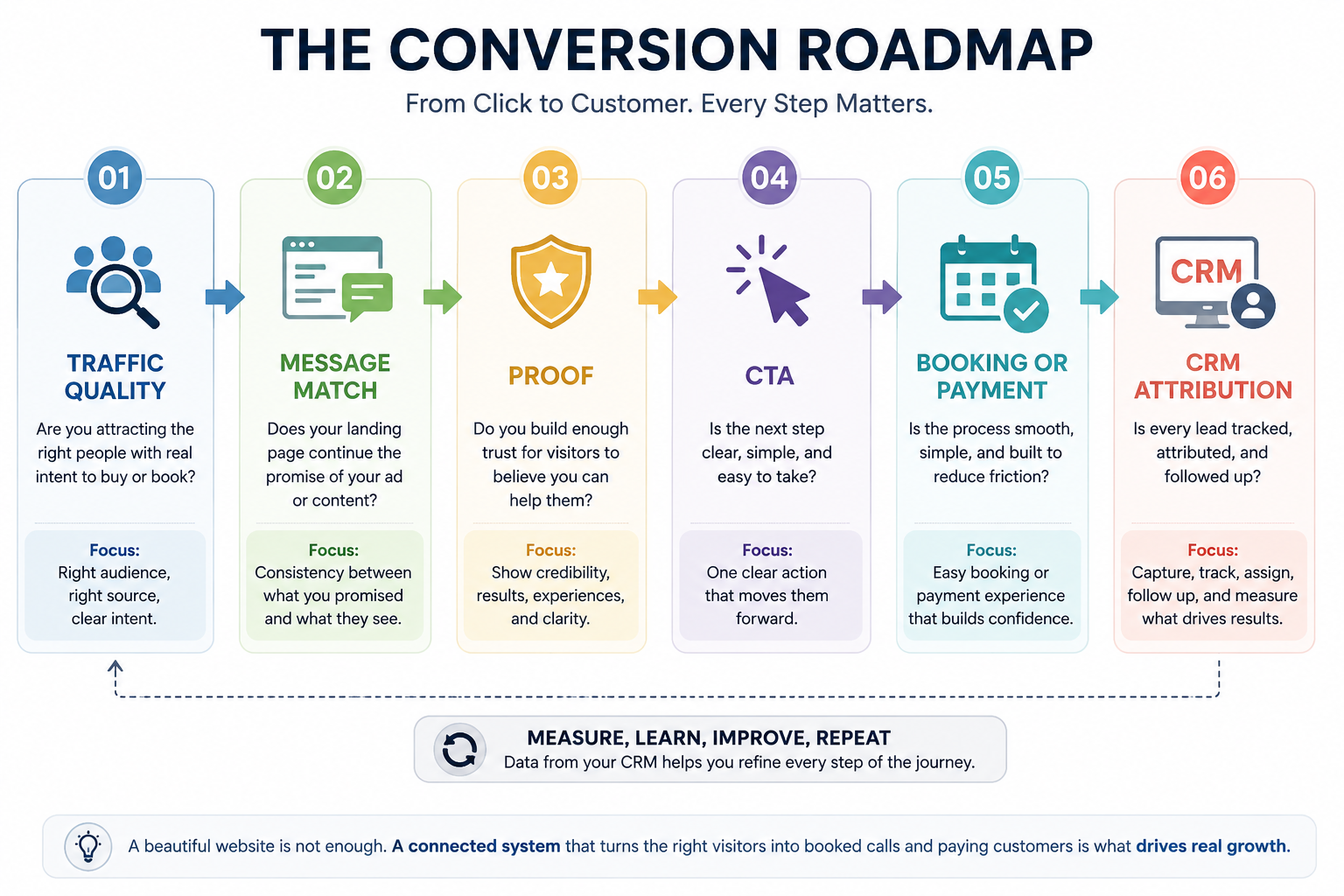
When I review a funnel, I naturally move through a sequence:
Traffic quality → Message match → Proof → CTA → Booking or payment → CRM attribution
I don't see these as six isolated checklist items.
I see them as connected stages in the customer's journey.
Traffic Quality asks whether the right people are arriving in the first place.
Message Match asks whether the landing page continues the promise that brought them there.
Proof helps the visitor understand why they should trust the business.
CTA gives them a clear next step.
Booking or Payment is where interest becomes action, so the process needs to be simple and easy to complete.
CRM Attribution closes the loop by helping the business understand what happened after the conversion.
The important part is the connection between each stage.
A business could have excellent traffic but poor message match.
Another could have a strong landing page but a confusing booking process.
Another could have a smooth booking experience but no CRM attribution, making it difficult to understand what is actually working.
The problem is different in each case.
That is why I prefer to understand the system before recommending more tools.
A beautiful website is still valuable. It just needs a job.
I don't think this means websites are becoming irrelevant.
Far from it.
Your website can be an important place for people to understand your business, establish credibility, explore your services, and learn more before making a decision.
But not every visitor needs to take the same path.
A person who is discovering your business may need the broader website experience.
A person who has already clicked on a specific campaign may need a focused landing page.
Someone who is ready to book may need a calendar.
Someone who has submitted an inquiry may need a follow-up process.
The strongest systems make these paths intentional.
The goal is not to remove people from the process.
It is to make the process easier for both the customer and the team.
What this looks like for a growing service business
Imagine a small Philippine consulting firm offering a paid business assessment.
Instead of sending every prospect to the homepage, the firm creates a dedicated page for the assessment.
The page explains who the assessment is for, what the client receives, what the process looks like, and why the assessment is useful.
The visitor books through the calendar.
The booking automatically creates or updates the contact in the CRM.
The client receives confirmation and reminders.
The consultant can see where the lead came from and what offer they booked.
If someone visits the page but does not book, the business has an appropriate follow-up process.
Now the landing page is doing more than presenting information.
It is one part of a working customer acquisition system.
That distinction becomes increasingly important as digital traffic becomes harder to earn and customer journeys become more fragmented.
This is where systems thinking changes the conversation
At PodCreate Systems, I approach this kind of work through the CALMA Framework™.
It starts with Clarity, understanding the business, offer, customer journey, and what is actually happening today.
Then comes Alignment, making sure the offer, funnel, CRM, and processes support the same customer journey.
Leverage is where automation, AI, and integrations can remove unnecessary manual work.
Make it Work is the implementation stage, where the actual systems are built and connected.
And finally, Activate and Handoff, where everything is tested, documented, and prepared for the people who will use it.
The important part is that automation comes after understanding.
I don't want to automate a confusing process.
I want to understand the process first, improve what needs improving, and then use technology where it genuinely helps.
The real opportunity is not simply getting more visitors
Marketing will continue to change. Search behavior will evolve. AI will keep reshaping how people discover businesses, paid advertising will shift, and platforms will come and go.
But the fundamentals of a good customer journey remain.
When the right person is ready to take action, your business needs to be ready to receive them.
That means having a clear message, a relevant offer, enough proof to build trust, and a straightforward next step. It means making booking or payment easy, while having the right systems behind the scenes to ensure your team knows what happened after that conversion.
Because getting someone to click is only the beginning.
So when you look at your website or landing pages, don't only ask:
"How many people are visiting?"
Also ask:
"What happens when an interested buyer visit our website?"
That question can reveal much more about the health of your marketing system.
And sometimes, the next growth opportunity isn't another campaign.
It is simply making the path from interest to action clearer.
